20/12/2025
DHV-2025 International Scientific Conference:When culture and humanity become core values in the era of integration and global aspiration
On December 20, 2025, in a solemn and academic atmosphere, Hung Vuong University of Ho Chi Minh City (DHV) successfully organized the DHV-2025 International Scientific Conference entitled “Culture and Humanity in the era of integration and global aspiration”. The conference brought together distinguished delegates and leading professors from Russia, China, South Korea, and Taiwan, along with Vietnamese experts, scientists, doctoral candidates, and scholars. The morning plenary sessions concluded successfully, offering fresh, multidimensional perspectives and establishing new frameworks for sustainable development in the digital era.
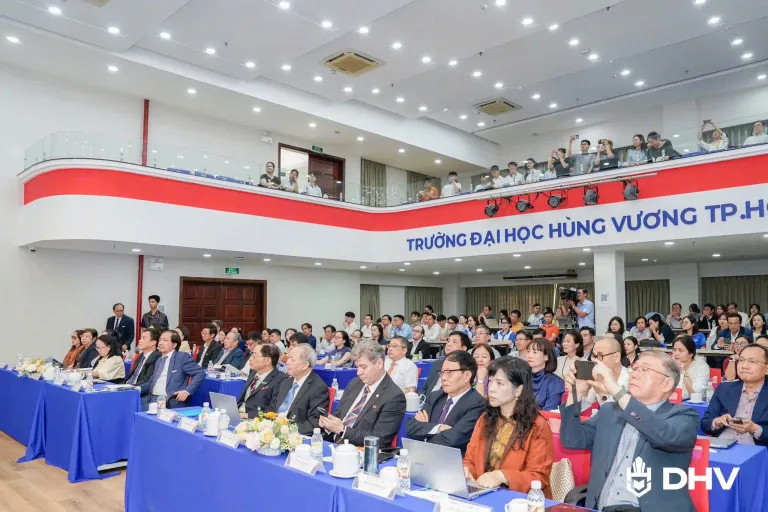
The DHV-2025 International Scientific Conference was attended by the University Board of Management, leaders of faculties, departments, and institutes of Hung Vuong University of Ho Chi Minh City, as well as scholars and administrators from domestic and international universities and research institutes (Russia, China, Taiwan, South Korea, etc.), together with doctoral candidates, trainees, and students both from within and beyond DHV.
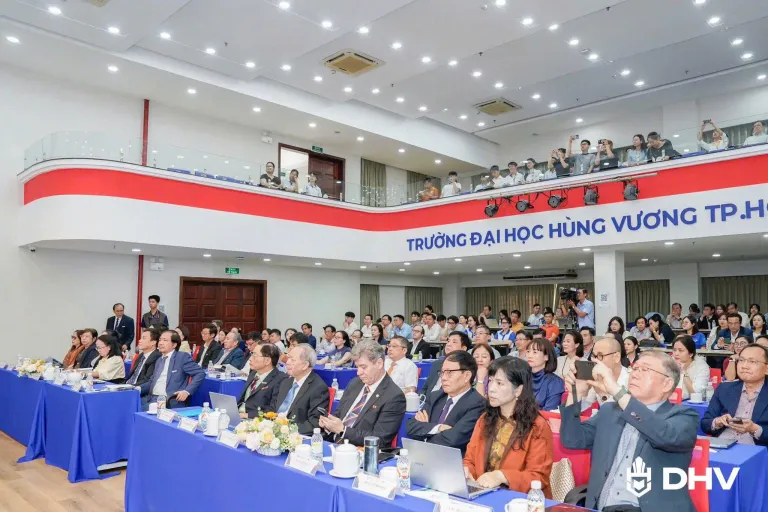
 Overview of the DHV-2025 International Scientific Conference “Culture and Humanity in the era of integration and global aspiration”
Strategic vision in education and training
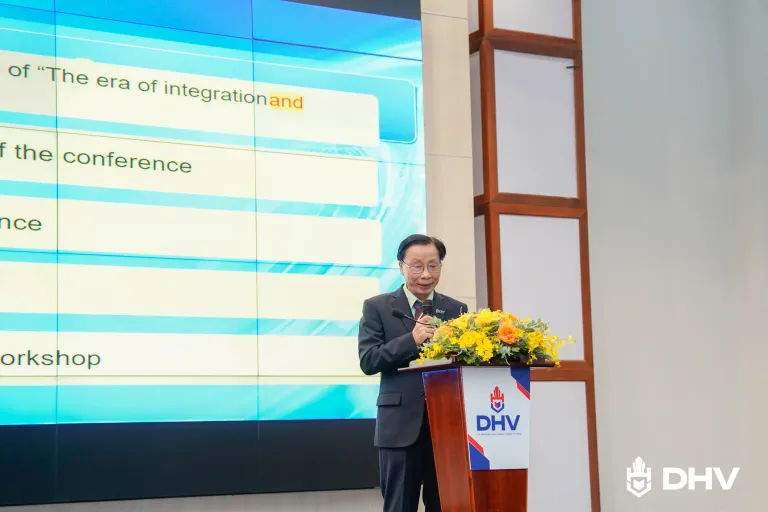
Opening the conference, Dr. Tran Viet Anh, Standing Vice Chairman of the University Council and Acting Vice President of Hung Vuong University Ho Chi Minh City, delivered a strategic keynote address. He clearly articulated DHV’s new educational philosophy, emphasizing: “Today’s conference vividly reflects the University’s development philosophy: People-centered development – Culture as the foundation – Innovation as the driving force – International integration as the pathway.” According to Dr. Tran Viet Anh, the mission of a modern university extends beyond providing professional knowledge; it is about cultivating individuals with strong cultural identity and integrity. In an era where artificial intelligence can replace humans in many tasks, culture and character remain the core values that empower Vietnamese students to confidently engage with the global community.
 Dr. Tran Viet Anh delivering the opening speech at the DHV-2025 International Scientific Conference
The conference was elevated to a new stature thanks to the attention and guidance of senior leaders at both national and municipal levels, reaffirming that culture is no longer solely an academic concern but a national strategic priority. Assoc. Prof. Dr. Trieu The Hung, Deputy Chairman of the National Assembly’s Committee on Culture and Social Affairs, delivered a directive speech highlighting an urgent requirement:“Cultural development must precede, accompany, and illuminate the path of development” He expressed his hope that the scientific arguments presented at the conference would serve as an important foundation for the National Assembly in refining legal frameworks and fostering a healthy digital cultural environment.
 Assoc. Prof. Dr. Trieu The Hung delivering a directive address at the conference
Sharing the same perspective, Ms. Dinh Thi Thanh Thuy, Deputy Head of the Propaganda and Mass Mobilization Commission of the Ho Chi Minh City Party Committee, reaffirmed the pivotal role of Ho Chi Minh City as the nation’s most dynamic cultural crossroads. She emphasized:“International integration is not merely an economic issue; fundamentally, it is an issue of people and value systems.” These insights served as strong motivation for scholars to continue their research and academic engagement.
 Ms. Dinh Thi Thanh Thuy, Deputy Head of the Propaganda and Mass Mobilization Commission of the Ho Chi Minh City Party Committee, delivering a directive address at the Conference.
From thought to integration and development
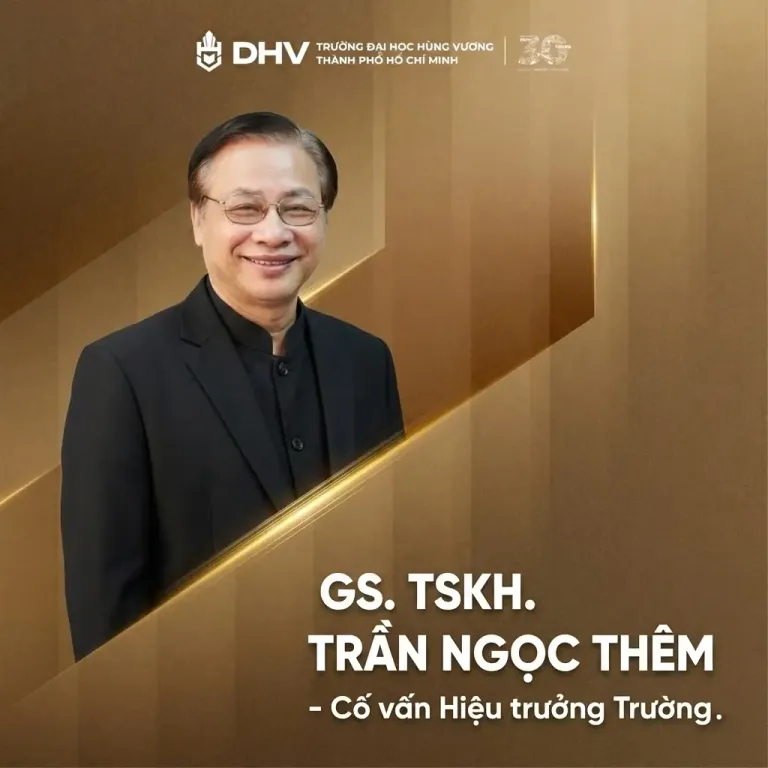
In the keynote report, Prof. Dr. Sc. Tran Ngoc Them, cultural researcher and Advisor to the President of Hung Vuong University Ho Chi Minh City, pointed out that in the context of integration and development, nations simultaneously cooperate and struggle to safeguard their autonomy. True global aspiration requires extraordinary cultural effort to transform external forces into internal national strength.
Drawing on Eastern philosophy, Prof. Tran Ngoc Them proposed a guiding principle for integration: “Integration without dissolution, multilateral engagement without losing principles. Culture is the ‘spiritual genome’—the collective memory of a nation. Losing this genome means integration becomes assimilation.”
 Picture 5: Prof. Dr. Sc. Tran Ngoc Them presenting the keynote report
His keynote report established a solid structure for the conference based on three pillars:“Culture and Humanity” – “Science and Education” – “Economy and Entrepreneurship.”He emphasized that while integration is an objective condition for development, global aspiration is the proactive response of a nation with vision and cultural confidence. In the era of integration and global aspiration, culture—the soul of development—ensures that integration means absorbing global excellence while preserving national identity.
Multidimensional dialogue and intellectual connectivity
Built upon strong theoretical foundations, the two morning plenary sessions featured lively discussions among domestic and international scholars, creating a vibrant intellectual panorama of culture and humanity in the era of integration and global aspiration.
Prof. Dr. Tran Van Doan (National Taiwan University) offered philosophical depth through his discussion on the role of aesthetic education in cultural development.
Prof. Dr. Sc. Vladimir Kolotov (Director of the Ho Chi Minh Institute, Saint Petersburg State University, Russia) delivered an impressive presentation on “Learning Strategies in Vietnamese Culture”, analyzing Vietnamese strategic thinking in national preservation through a comparative lens closely linked to Ho Chi Minh’s ideology.
Prof. Dr. Bae Yang-soo (South Korea) and Prof. Dr. Duong Kien (China) shared practical lessons from Northeast Asia on preserving cultural identity in higher education and student cultural exchange.
Prof. Ho Sy Quy (Hanoi) energized the conference with his discussion on “The Cultural Dimensions of the Middle-Income Trap,” fostering intellectual engagement among scholars.

The scientific papers presented—ranging from digital heritage preservation to cultural entrepreneurship models—demonstrated how academic theory can be thoughtfully and profoundly translated into practice. Scholars engaged in constructive discussions and provided feedback to doctoral candidates, contributing to the ongoing inheritance and development of culture, knowledge, and humanity.
The morning session of the DHV-2025 International Scientific Conference laid a strong theoretical foundation and stimulated sharp intellectual inquiry, paving the way for practical, multidimensional discussions in the afternoon sessions across specialized panels.