19/12/2025
When culture and humanity become core values in the era of integration and global aspiration
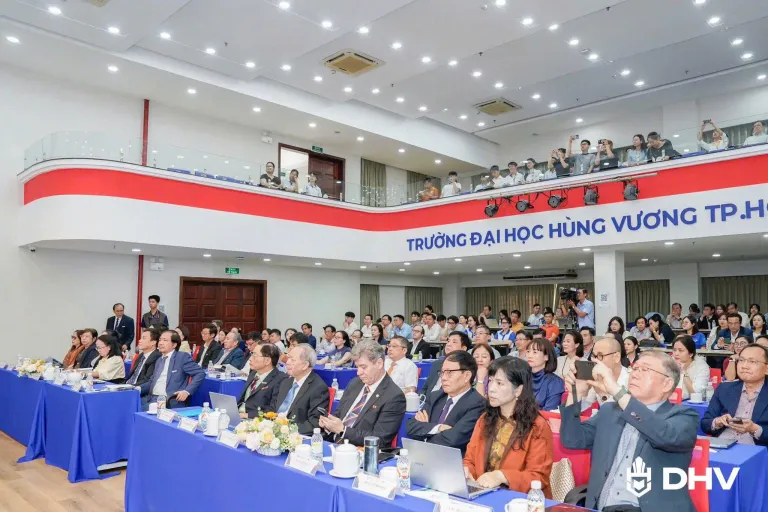
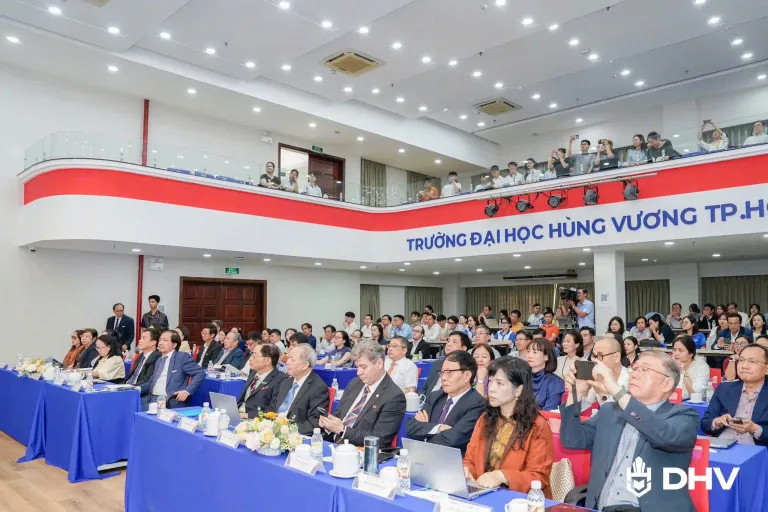
On December 20, 2025, at the campus located at 194 Le Duc Tho Street (An Nhon Ward, Ho Chi Minh City), Hung Vuong University Ho Chi Minh City (DHV) organized the DHV-2025 International Scientific Conference entitled “Culture and Humanity in the Era of Integration and Global Aspiration.”
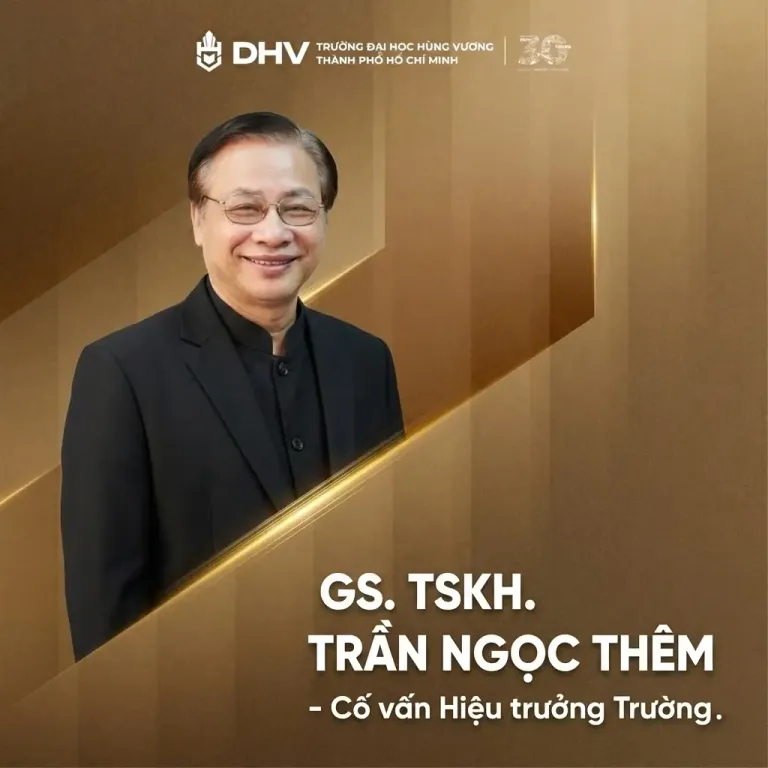
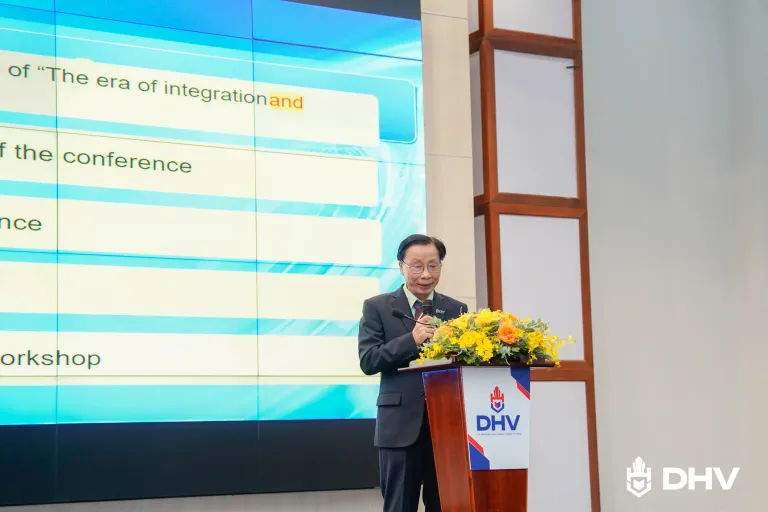
The conference served as a strong affirmation of the University’s strategic vision in a new historical trajectory—one that places culture and humanity at the center amid trends of integration and globalization. With the keynote report delivered by Prof. Dr. Sc. Tran Ngoc Them, cultural researcher and Advisor to the President of Hung Vuong University Ho Chi Minh City, the conference opened profound lines of thought and redefined the position of culture and humanity in an increasingly interconnected world.
Prof. Dr. Sc. Tran Ngoc Them – Cultural Researcher and Advisor to the President of Hung Vuong University Ho Chi Minh City (DHV), delivering the keynote report at the DHV-2025 International Scientific Conference “Culture and Humanity in the Era of Integration and Global Aspiration.”
 Prof. Dr. Sc. Tran Ngoc Them
From a “flat world” to “selective globalization”
Reflecting on the first 25 years of the 21st century, humanity has experienced dramatic transformations: from the peak of globalization to global financial crises, from the rise of populism to the COVID-19 pandemic and increasingly complex geopolitical conflicts. Prof. Dr. Sc. Tran Ngoc Them observed that the world is no longer “flat” in the sense once described by Thomas Friedman.
Instead, humanity is entering an era of “selective globalization” and “partial deglobalization.” This is a flexible, multipolar world in which nations must simultaneously open up to cooperation while resolutely safeguarding sovereignty and national identity. In this context, the essential question is no longer merely “How do we integrate?” but rather “Who are we in the process of integration?”

“Global aspiration” – A national desire inspired by the legend of Thanh Giong
The phrase “the era of global aspiration” has become a historical keyword in Vietnam since late 2024, following strategic statements by General Secretary To Lam. While the notion of a “new era” has existed since antiquity, the concept of “global aspiration” represents a distinctly Vietnamese innovation.
From a cultural perspective, Prof. Dr. Sc. Tran Ngoc Them interpreted the word “aspiration” through three layers of meaning: physical expansion, positive development, and the effort to reach the highest level of achievement. The image of “aspiring upward” immediately evokes Saint Giong, a symbol of extraordinary growth and transformative leap in response to urgent historical demands.
World history has recorded great national “leaps” of development: Japan during the Meiji Restoration, South Korea under Park Chung-hee, and Singapore under Lee Kuan Yew. Vietnam, after nearly 80 years of nation-building and 40 years of Renovation (Đổi Mới), has now reached sufficient “maturity” to enter a similar era of accelerated development. This is not merely a declaration, but an emerging reality.
The philosophy of “Harmony without uniformity” – The integrity of the noble Individual
A distinctive highlight of Prof. Dr. Sc. Tran Ngoc Them’s keynote was the application of Eastern philosophy to governance and integration. He recalled Confucius’s teaching:
“The noble person seeks harmony but not uniformity; the petty person seeks uniformity but not harmony.”
In the era of integration, Vietnam adopts the posture of the “noble individual”: embracing openness, engaging in dialogue, and respecting international norms, while steadfastly preserving independence, sovereignty, and cultural identity. Vietnam seeks to “integrate without dissolving.”
Conversely, passively following foreign trends and losing national identity reflects a lack of cultural confidence and leads to assimilation. At this point, culture functions as a “spiritual genome,” ensuring that development remains human-centered, ethical, and sustainable.
Three pillars for sustainable development
The DHV-2025 International Scientific Conference brought together 69 research papers from domestic and international scholars (Russia, China, South Korea, Taiwan), focusing on three core pillars:
· Culture and Humanity: The spiritual foundation and central resource. In the new era, individuals are not only national citizens but also global citizens who retain national identity while harmonizing tradition and modernity.
· Science and Education: The driving force of strength. The conference emphasized renewing educational philosophy toward openness and creativity, strengthening the linkage between universities and enterprises in the digital era.
· Economy and Entrepreneurship: The pathway to escaping the middle-income trap. Building a knowledge-based economy grounded in internal strengths enhances national competitiveness in the global arena.
The interaction among these three pillars forms a comprehensive development ecosystem in which spiritual values promote material progress, and material advancement reinforces cultural vitality.

DHV-2025: Hung Vuong University of Ho Chi Minh City’s mission at the 30-year milestone
The DHV-2025 International Scientific Conference holds special significance as part of the activities celebrating the 30th anniversary of Hung Vuong University Ho Chi Minh City (1995–2025).
As a higher education institution with a strong academic tradition, DHV is striving to affirm its role in developing human resources for the “era of global aspiration.” Prof. Dr. Sc. Tran Ngoc Them emphasized that faith in the soft power of culture and the creative capacity of the younger generation is the key to realizing national aspirations.
The DHV-2025 Conference serves as a catalyst for shaping a new intellectual framework that reflects contemporary global trends and the nation’s long-term vision. It contributes to nurturing culturally grounded individuals who carry Vietnamese identity while confidently integrating into globalization and entering a new era of development.
The conference also aspires to establish the concept of the “era of integration and global aspiration” as a new intellectual model—one that reflects the spirit of the times and the vision and aspirations of the Vietnamese nation within the flow of world civilizations. It seeks to further refine theoretical frameworks for sustainable development based on culture and humanity, inspire concrete policies and models for education, science, and creative economy, and disseminate Vietnam’s aspiration for advancement in the 21st century.